How Does Farm Altitude Affect the Taste of Coffee?
Coffee cultivation altitude is one of the most important factors that defines the character of the cup that reaches you. The higher the elevation above sea level, the more noticeably growing conditions change, starting from temperature all the way to the speed at which cherries ripen. And all of this is directly reflected in the taste of the coffee and the quality of the beans at every stage of production. In this article, we will understand how coffee cultivation altitude affects the tasting experience, with examples of the finest specialty coffees produced by high-altitude farming. We will also clarify the ideal altitude for filter coffee and espresso lovers.
What Does Farm Altitude Mean?
Farm altitude is the distance at which coffee trees are grown above sea level, and it is usually measured in meters.
Coffee cultivation altitude is not a random number, it is a fundamental factor in determining the coffee's growing environment, such as:
- Temperature.
- Oxygen levels.
- The speed at which cherries ripen.
In general, the higher the farm, the cooler the climate becomes, which slows the growth of and causes them to ripen over a longer period.
How Does Coffee Cultivation Altitude Affect Bean Growth and Coffee Taste?
Coffee cultivation altitude plays a direct role in shaping bean quality from the moment of growth all the way to the final tasting.
At high altitudes, temperatures are lower, and this leads to:
- Slower bean growth, which helps develop more complex and balanced flavors.
- Increased density, the beans become harder and more concentrated, which is reflected in coffee quality during .
- More pronounced acidity, coffee grown at altitude typically has a bright, pleasing acidity that is highly valued in .
- More distinct flavors, such as fruity or floral notes, especially in Ethiopian coffee and Colombian coffee.
As for low-altitude farms, where temperatures are higher, the coffee ripens more quickly, which can result in a taste that is less complex and shallower in depth compared to specialty coffee beans grown at high altitudes.
Why Are High-Altitude Coffee Farms Associated with More Complex Flavors?
Because the environment there forces coffee beans to grow more slowly. This slow ripening allows a wider variety of chemical compounds to form inside the bean, such as:
- Sugars.
- Organic acids.
- Aromatic oils.
All of these compounds are responsible for the multiple flavor layers in the cup. At high altitudes, lower temperatures reduce the plant's metabolic rate.
Instead of the cherry ripening quickly and producing a relatively flat , it takes its time to develop, and multiple flavors emerge, such as fruits, flowers, chocolate, and sometimes nutty or caramel notes in specialty coffee.
The Relationship Between Coffee Cultivation Altitude and Acidity
The higher the coffee cultivation altitude, the higher the acidity in the cup tends to be.
The reason is that the relative coolness at high elevations slows the breakdown of acids inside the bean and helps preserve them more clearly.
It is worth noting that this acidity does not mean an unpleasant sour taste, rather, it is a balancing element that gives the coffee vibrancy and clarity of flavor.
At lower altitudes, where temperatures are higher, acidity tends to decrease or become less pronounced, resulting in a quieter cup with less complexity in the flavor sensation.
How Does Coffee Cultivation Altitude Reflect on the Sweetness and Body of Coffee?
Coffee cultivation altitude also directly affects sweetness and body. At high altitudes, the slow ripening allows natural sugars to accumulate inside the bean, giving a sensation of cleaner and more distinct sweetness when tasted.
As for body, high-altitude coffee typically has a more balanced and slightly lighter body compared to some low-altitude coffees, which may be heavier but less nuanced in flavor.
The Difference Between Coffee Grown in High-Altitude and Low-Altitude Regions
Coffee differs noticeably depending on the altitude of the growing region, as elevation directly affects the speed of bean growth, sugar concentration, and acidity level.
This difference is ultimately reflected in the body, flavor, and taste of the coffee in every cup.
The table below highlights the key differences between coffee grown in high-altitude and low-altitude regions:
| High-Altitude Coffee | Low-Altitude Coffee |
Growth Rate | Slow | Fast |
Flavor | More complex and varied | Simpler and less layered |
Acidity | More pronounced and brighter | Less pronounced |
Sweetness | Cleaner and more balanced | Less concentrated |
Body | Lighter and more refined | Relatively heavier |
Bean Density | High | Lower |
Common Examples | Ethiopian and Colombian coffee | Some types of Brazilian coffee |
Examples from Ethiopia of Coffee Grown at High Altitudes
is considered one of the most well-known examples of coffee grown at high altitudes, typically cultivated on farms that exceed 1,800 to 2,200 meters above sea level.
Coffee cultivation altitude here gives it a very distinctive flavor character.
Among the finest Ethiopian specialty coffees offered by South Coffee roaster, known for their complexity and flavor diversity, are:
- : one of the finest Ethiopian specialty coffee beans from high-altitude farms. It has a balanced character with hints combining honey and tropical fruits, appropriate acidity, and touches of jasmine.
- : with a clear flavor reminiscent of red apple, along with refreshing touches of bergamot and grape.
- : the ideal choice for specialty coffee lovers who enjoy flavors evoking vanilla, mandarin, and touches of jasmine.
Examples from Colombia of Coffee Grown at High Altitudes
Colombian coffee is also grown in high mountain regions, generally between 1,200 and 2,000 meters, and this gives it a distinctive balance between sweetness and acidity.
Among the finest high-altitude Colombian specialty coffees available at South Coffee roastery are:
- : one of the standout choices for high-altitude specialty Colombian coffee. It combines flavors of cacao and refreshing sour lemon with hints of brown sugar.
- : one of the finest specialty coffee crops coming from the heights of the Huila mountains. It has distinctive flavors combining tropical fruits with coconut and milk chocolate.
- : a perfect choice for lovers of high-altitude grown coffee, offering distinctive flavors combining fresh fruits and passion fruit.
Do Higher Coffee Farms Always Guarantee Better Bean Quality?
Not necessarily. Although coffee cultivation altitude is an important factor in coffee quality, it is not the only factor. Final quality also depends on other factors such as:
- The variety.
- The soil.
- The harvesting method.
Therefore, a low-altitude coffee farm with excellent management may produce better coffee than a high-altitude farm that is poorly cared for.
How to Read Altitude on a Coffee Label?
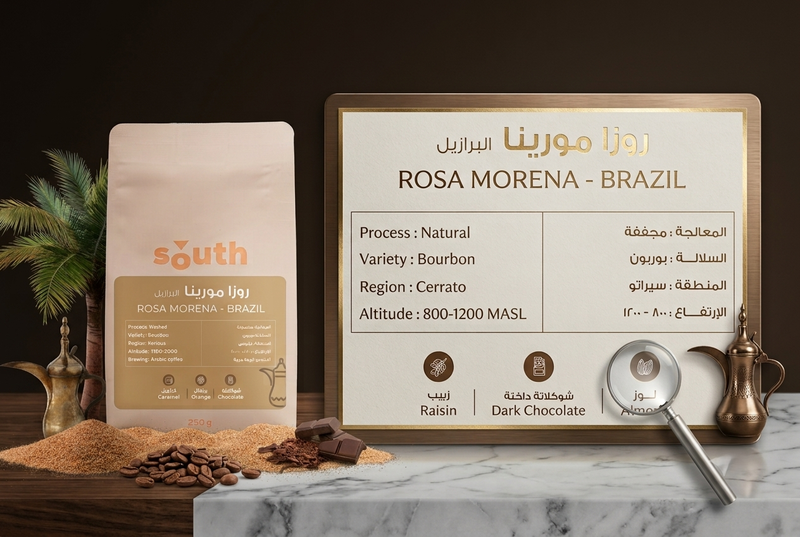
Altitude is usually written on a coffee label in meters above sea level (MASL or m.a.s.l).
The higher this number, the greater the likelihood of brighter acidity and more complex flavors. For example:
- 1,200–1,500 m.a.s.l = Medium-altitude coffee.
- 1,600–2,000 m.a.s.l = High-altitude coffee.
- 2,000+ m.a.s.l = Very high-altitude coffee.
What Is the Right Coffee Cultivation Altitude for Filter Coffee Lovers?
lovers generally prefer coffee with distinct flavors and high complexity, so the ideal coffee cultivation altitude is 1,600 to 2,200 meters above sea level.
This altitude provides bright acidity, natural sweetness, and distinct fruity or floral flavors.
It is also very well suited when choosing Ethiopian and Colombian coffee for filter brewing.
What Is the Right Coffee Cultivation Altitude for Espresso Lovers?
, on the other hand, requires a clearer balance and body, so the ideal coffee cultivation altitude is 1,200 to 1,800 meters above sea level.
This range provides a more cohesive body, less intense acidity, and more consistent sweetness, and it is well suited for Brazilian coffee and some medium-altitude Colombian varieties.
In the end, it is clear that coffee cultivation altitude is not just a geographical number, it is a fundamental factor that contributes to shaping the character of the cup in terms of flavor, acidity, and body.
Understanding this factor helps you choose the coffee that suits your taste, whether you are a filter coffee or espresso lover.
If you are looking for a coffee experience built on careful selection from high-altitude farms, offers you a curated collection of the finest specialty coffee beans, with a variety of origins and roast levels to suit different tastes.
South Coffee also provides options with consistent quality and competitive prices that meet the needs of cafés and coffee lovers alike. Browse our now and choose the coffee that suits you.
FAQs
What is the ideal altitude for coffee cultivation?
It generally ranges between 1,400 and 2,000 meters above sea level, where the relative coolness helps produce denser beans with more distinct flavor.
How does altitude affect the taste of coffee?
The higher the altitude, the more pronounced the bright acidity and the more complex the flavors that emerge, while lower altitudes produce simpler and less intense coffee.
Is high-altitude coffee always better quality?
Not always, quality also depends on the soil, harvesting, and processing, not altitude alone.
Does altitude affect the sweetness of coffee?
Yes, high altitudes help develop clearer natural sweetness as a result of slower ripening.
Does coffee differ by altitude within the same country?
Yes, even within the same country, flavor can differ noticeably depending on the altitude difference between farms.